
If you run a support team, you've been pitched "conversational AI" more times than you can count — usually as a chatbot wearing a nicer outfit. This guide cuts through it: what conversational AI for customer service actually means, where it genuinely helps, where it falls down, and how to tell whether it fits your business.
The short version: conversational AI for customer service is software that understands a customer's request in natural language and responds usefully — and, in its most capable form, resolves the request by taking action rather than just replying. That last part is where most of the value lives, and where most tools fall short.
Conversational AI vs. the chatbot you already hate
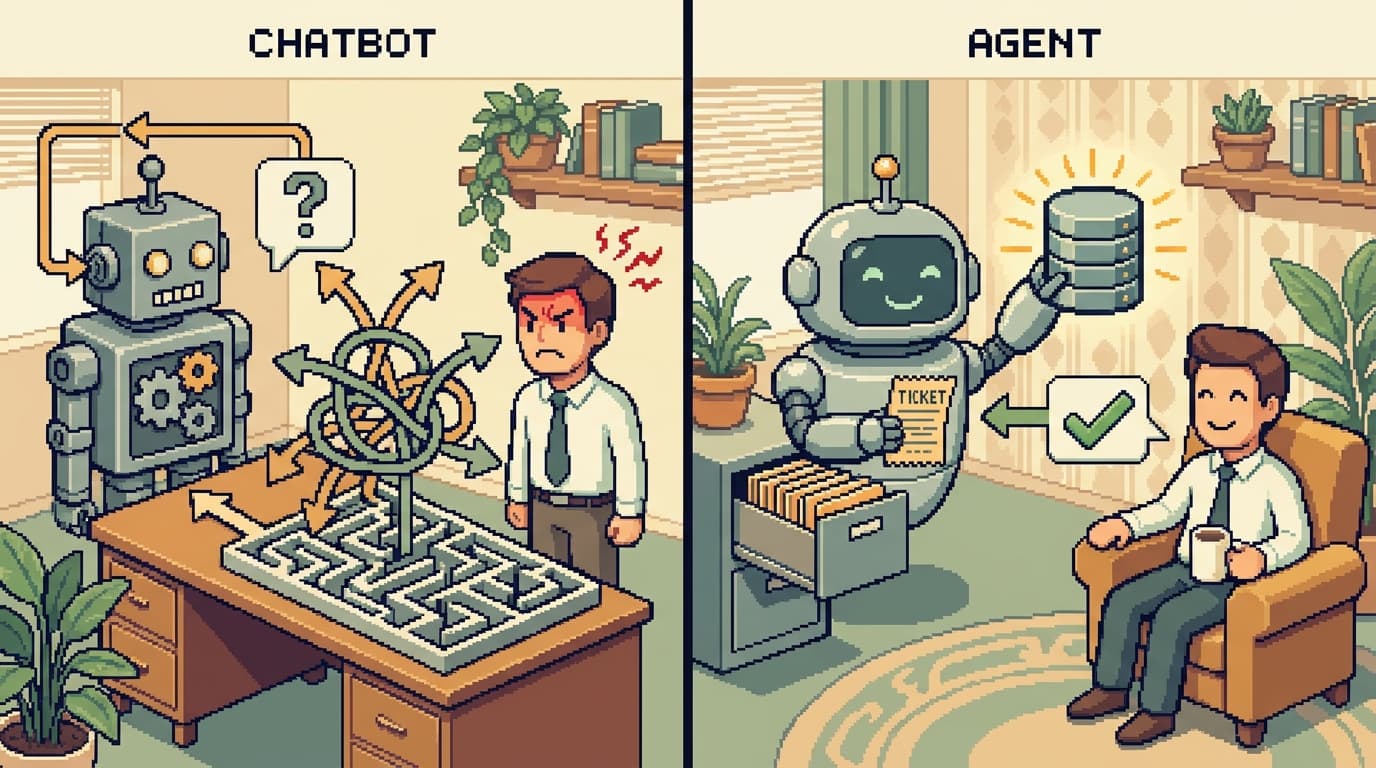
Everyone has rage-clicked through a support bot that loops "I didn't quite get that" until it dumps you into a queue. That's a scripted chatbot: it matches your words against a decision tree and, the moment reality steps outside the script, it gives up.
Modern conversational AI is different in degree and in kind. It understands intent rather than keywords, holds the thread of a conversation, and — this is the leap — can be connected to your actual systems so it does things. The distinction that matters isn't "old chatbot vs. new chatbot." It's deflection vs. resolution:
- A deflection tool answers what it can and escalates the rest. Its goal is to keep tickets away from humans.
- A resolution tool — an AI customer service agent — reads the request, checks the order, applies the refund within policy, updates the record, and replies. Its goal is to finish the job.
Both get called "conversational AI." Only one changes your support economics.
What it can genuinely handle
Conversational AI is at its best on the high-volume, well-defined requests that make up the bulk of most support queues:
- Order and account status — "where's my order," "what plan am I on," "when does this renew."
- Policy-bound actions — refunds, cancellations, address changes, and resets that follow clear rules.
- Knowledge questions — anything answerable from your help docs, answered in context instead of as a link dump.
- Triage and routing — reading an incoming message, working out what it's about and how urgent it is, and getting it to the right place.
These are exactly the tickets that are tedious for humans and easy to get wrong when someone's rushing. Handing them to an agent frees your team for the conversations that actually need a person.
Where it falls down (and should hand off)
Being honest about the limits is what separates a useful deployment from a frustrating one. Conversational AI should not be the last line on:
- Emotionally charged or high-stakes issues — a furious customer or a billing dispute needs a human, fast.
- Ambiguous requests that can't be resolved without judgement or missing context.
- Irreversible or sensitive actions — large refunds, account deletions, anything you'd want a person to approve.
A well-built agent knows its own limits and escalates these with context — a summary of what the customer wants and what it already checked — so the human picks up mid-stride instead of starting over.
What "responsibly deployed" actually means
The difference between an agent you trust and one you switch off after a week is deployment discipline, not model choice. The patterns that matter:
- Scoped permissions. The agent can touch only the systems and actions its job requires, and you can revoke that access instantly.
- Approval gates. High-stakes actions are recommended by the agent and confirmed by a human — it drafts the big refund, a person approves it.
- Audit logs. Every action is recorded, so you can always answer "why did it do that?"
- A graceful human handoff. Escalation is a first-class feature, not an error state.
If that framing sounds familiar, it's the same discipline behind any production AI agent — customer service is just one of the clearest places to apply it.

How to know if it fits — and how to start
Conversational AI pays off when your support has real volume, a meaningful share of repetitive and rule-based tickets, and resolutions that depend on your own systems and policies. If your support is low-volume or every case is bespoke, the economics aren't there yet — and a good partner will tell you so.
If it does fit, start narrow. Pick one high-volume, low-risk ticket type — order status, say — let an agent own it end to end, measure the result, and expand from there. The teams that succeed automate one workflow and grow it; the ones that get burned try to replace their whole support function in a quarter.
Quick answers
Is conversational AI just a chatbot? A scripted chatbot is one (limited) form of it. The capable form understands intent, holds context, and connects to your systems to resolve requests — not just answer them.
Will it replace my support team? No — it removes the repetitive volume so your team spends its time on the cases that need a human. The agent handles the routine; your people handle the judgement.
What does it work with? Any helpdesk or channel with an API — Zendesk, Intercom, Gorgias, Freshdesk, email — plus your own databases, so it can actually resolve, not just reply.
Is it safe? When deployed with scoped permissions, approval gates on sensitive actions, and full audit logs, yes. The risk isn't the technology — it's giving an unsupervised system too much permission too early.
If you're weighing whether an agent could take the repetitive load off your support team, that's the conversation we have every week. Read more about AI customer service agents, or book a free consultation.